
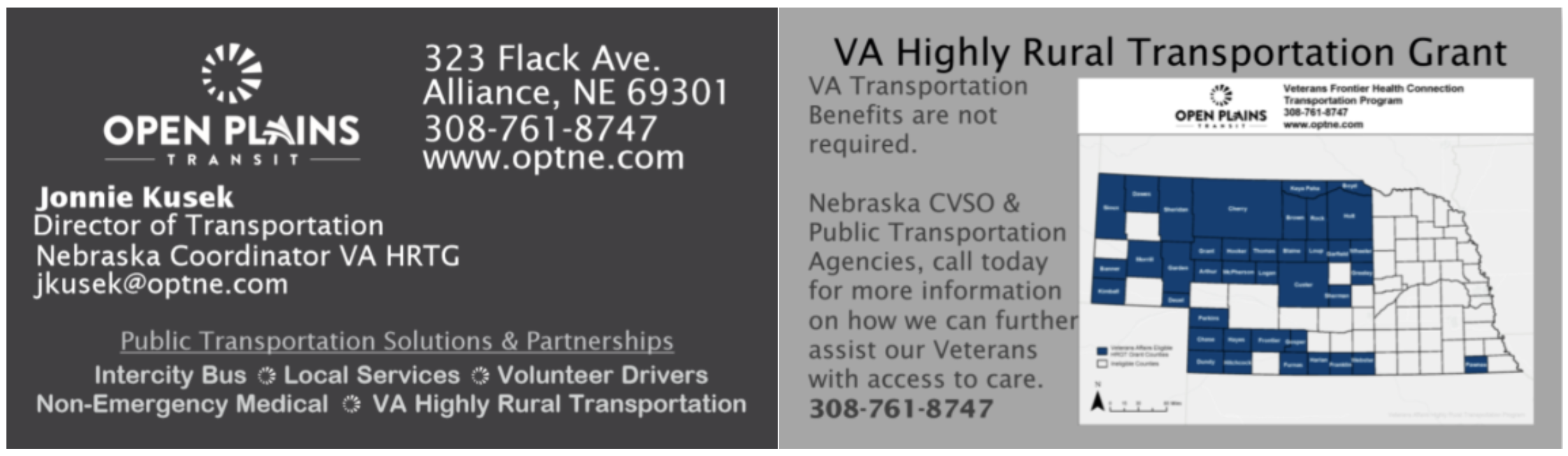
Jonnie Kusek, Director of Transportation
Earlier this month, the Nebraska Department of Transportation announced that it is partnering with the University of Nebraska at Omaha’s Center for Public Affairs Research to conduct a study of the intercity bus services available in Nebraska.
NDOT administers the Federal Transit Administration’s Section 5311(f) funding for rural intercity bus services in Nebraska, and the survey is an important element of the consultation process required under this program.
A major focus of this effort is to determine the need for state and federal assistance to maintain current services or provide expanded connections from rural areas to connect with the national intercity bus network. What they are not mentioning is that per the Federal Transportation Administration, it is also meant to ensure access to larger urban centers for health care, education, and employment through scheduled, long-distance routes.
“Input from the meetings will be used by NDOT as it considers using federal funds to maintain the existing intercity services or provide additional intercity services.” These are words quoted by the NDOT. There appears to be a lack of consideration for using state funds to maintain existing services. There has been a lot of news lately regarding the budget reductions to rural transportation in Nebraska that keeps getting blamed on the lack of federal funding, which is quite interesting, as Nebraska has received an increase of federal funds every single year for the past five years, this is in addition to FTA Section 5311(b)(3) funds which states may use for nonurbanized transit activities in four categories: training, technical assistance, research, and related support services.
In the past budget application to the NDOT for intercity bus operations, participants were required to submit their intercity bus applications without requesting state funds in the process. This application process and funding is separate from the process that allows for local transportation services, although, that funding can be used for services outside of local communities, but it comes at much higher costs to those communities. The lack of consideration for use of state funds to leverage additional federal funding to maintain existing intercity services, many believe, leaves the entire Nebraska intercity bus industry in jeopardy.
Intercity bus service remains one of the most important and cost-effective transportation links for rural Nebraska. For many communities, it is the only available form of public transportation connecting residents to employment centers, healthcare services, educational institutions, and regional economic hubs. Maintaining a reliable statewide intercity network is therefore not simply a transportation issue—it is a matter of economic development, rural sustainability, and equitable mobility.
The Section 5311(f) program provides a critical federal framework for supporting intercity bus services in rural areas. Under current program rules, federal participation supports up to 50 percent of net operating costs and 80 percent of capital and administrative expenses. However, without sufficient State participation to help meet non-federal match requirements, many providers—particularly nonprofit public purpose organizations—face significant barriers to sustaining or expanding service.
Nebraska State Statute 13-1213 clearly recognizes the importance of supporting intercity transportation. The statute authorizes State funding for qualified public purpose organizations and allows NDOT to contract for intercity bus services with providers owned by those entities, such as Open Plains Transit (OPT/Senior Services, Inc.), who provides intercity bus services to approximately one-third of the state, expanding into regions of South Dakota and Wyoming, to serve the needs of Nebraskans. OPT has worked for over ten years to rebuild routes that disappeared when intercity bus services were deregulated in the early 1980’s, which allowed carriers the ability to shed unprofitable routes. It left most of western Nebraska communities landlocked. The rebuilding of these routes has served western Nebraskans with intermodal connection to bus and airlines, those services previously mentioned, and most recently, assisting passengers to reach critical dialysis treatments that on average are a 120-mile one-way trip. Many such passengers travel an average of four hours, three times per week, for a total of twelve hours every week, to receive life sustaining treatment because the dialysis program ended in Chadron, NE or there is no availability in the community in which they reside. The statute also authorizes the use of funds to support the non-federal share of vehicle purchases necessary to start or maintain intercity services.
Reinstating State participation in the program would advance several key statewide priorities.
First, restoring State funding will strengthen rural economic mobility. Many rural communities depend on transportation links to access regional labor markets. Reliable intercity bus service allows workers to commute or travel for employment opportunities that may not exist locally. Without these connections, rural employers face workforce shortages, and residents are forced to relocate to larger metropolitan areas to maintain employment access. Sustaining intercity transportation therefore supports workforce participation, business development, and long-term economic stability in rural Nebraska.
Second, intercity bus networks play a vital role in supporting access to healthcare and essential services. Rural residents often travel long distances to reach hospitals, specialty medical providers, veterans’ services, and higher education institutions. Transportation barriers frequently result in missed appointments, delayed care, and reduced access to educational opportunities. Reliable intercity transportation directly improves public health outcomes and expands educational access for rural residents.
Third, restoring the State funding component ensures Nebraska can fully leverage available federal transportation resources. Without adequate State or local matching funds, federal dollars designated for rural mobility risk going unused. Reinstating State participation allows Nebraska to maximize federal investment while strengthening the overall statewide transportation network.
Fourth, nonprofit public purpose organizations frequently serve rural corridors that are not financially viable for private operators. These organizations operate with a public service mission and routinely coordinate with local governments, healthcare providers, and community organizations to provide transportation access in areas where no other service exists. However, many rural communities lack the financial capacity to provide the local match required under federal programs. Allowing qualified nonprofit providers to receive funding at 100 percent of eligible costs where necessary would ensure that essential transportation lifelines are not lost simply due to limited local funding capacity.
Finally, maintaining a strong intercity bus network supports broader statewide transportation resilience. Intercity bus systems provide options and flexibility within the transportation network, offering critical alternatives during severe weather events, emergencies, or service disruptions in other transportation modes.
This issue is also of increasing interest to policymakers and community stakeholders across the state. Rural mobility, workforce access, and healthcare transportation are priorities frequently discussed in legislative and policy forums. Ensuring that the Section 5311(f) program remains fully supported helps demonstrate that Nebraska is proactively addressing rural transportation needs and responsibly leveraging federal transportation resources available to the state.
In addition, this request reflects concerns expressed by a broad coalition of rural communities, nonprofit transportation providers, healthcare organizations, workforce development partners, and regional economic development stakeholders who recognize the essential role intercity transportation plays in sustaining rural Nebraska.
For these reasons, reinstating State funding for the Section 5311(f) Intercity Bus Program represents a strategic investment in Nebraska’s rural economy, public health infrastructure, workforce mobility, and transportation resilience. It will also ensure that Nebraska continues to make full use of available federal resources intended to support rural transportation connectivity.
Community members are encouraged to complete the online survey, share constructive feedback with the Nebraska Department of Transportation and elected officials, and support restoration of the State funding portion of the Section 5311(f) program. Public input can also help advance policies allowing qualified nonprofit public purpose organizations to receive funding at 100 percent of eligible project costs when necessary to maintain or expand service in underserved areas.
Comments may be submitted through the confidential online survey at ndot.info/656469. Responses must be received by April 30.
Public Assistance: Hard copies of the survey may be completed at the Open Plains Transit Depot, located at 323 Flack Ave., Alliance, NE or over the phone at 308-761- 8747, Monday-Friday, 9-1, through April 30 th.
Supporting public transportation for Nebraska’s rural and frontier communities is
critical to their futures.
